Menu
Quest 1 - 9th grade
Reasoning

Course Highlights:
Everyday Debate and Discussion is a classical rhetoric and critical thinking course designed to teach students how to think logically, communicate persuasively, and engage in respectful Socratic conversation, informal discussion, and formal debate.
Lit/Comp

The Lost Tools of Writing during the first semester allows students to continue in the classical art of rhetoric.
During the second semester, students engage in Writing and Rhetoric 8 which is a method of teaching writing in conjunction with critical thinking and speaking. Throughout the school year, students will be writing multiple well-crafted, six-paragraph expository essays comparing two subjects.
Course Highlights:
Science
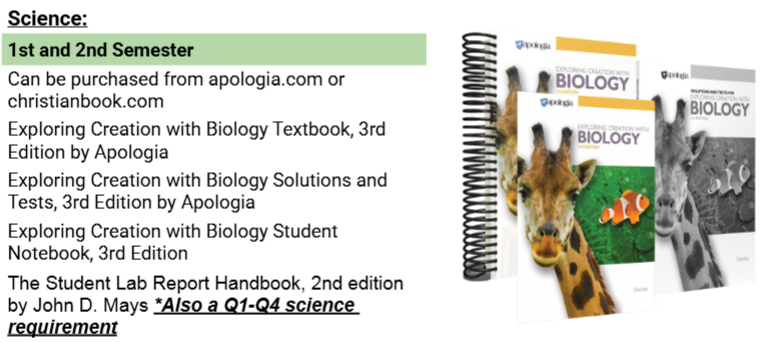
This course emphasizes a Biblical worldview, exploring God’s creation while addressing scientific concepts such as evolution in comparison to creationism. The curriculum is lab-intensive, with students performing experiments, dissections, and interactive activities to reinforce learning
Course Highlights:
Foreign Language

Course Highlights:
All Quest B students that have completed First and Second Form Latin continue on to Third Form which builds on the foundation previously laid, reviews earlier material, and advances grammar, reading, and cultural context.
History

Course Highlights:
Master Books’ Civics and the Constitution is a high school-level Civics curriculum that teaches how the U.S. government works from a biblical worldview, emphasizing the Founding Fathers’ principles and the Constitution’s original intent. The course is designed to help students understand not only how government works, but how it ought to work—rooted in moral and religious foundations.
Semester Project: Students orally recite a 5-7 minute memorized historical document
Math/
Enrichment
Course Highlights:
Quest 1 students must maintain a core math program at home.
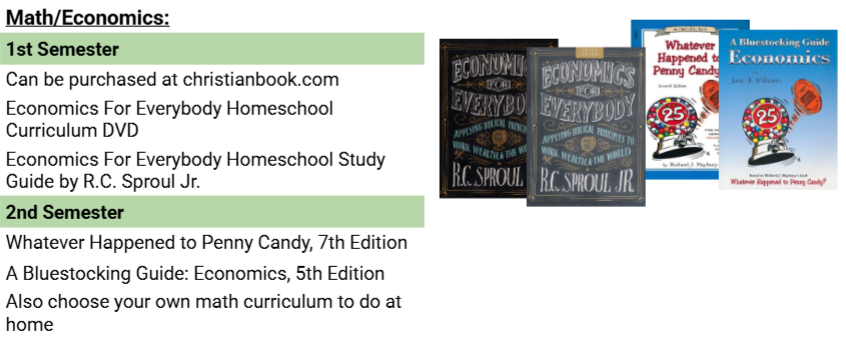
This class serves as an engaging enrichment to demystify economics by focusing on real‑world applications rather than complex mathematics. It emphasizes thinking like an economist—making choices by comparing alternatives, considering opportunity costs, and thinking on the margin.